URBAN SMILES DENTAL CLINIC - Dentist in Chembur | Advanced Root canal treatment, Smile Designing, Implants & Teeth whitening

Painless Root Canal Treatment in Chembur – Save Your Natural Teeth
Are you suffering from severe tooth pain, sensitivity to hot and cold, or swollen gums? You might need a Root Canal Treatment (RCT). At Urban Smiles Dental Care, we specialize in saving natural teeth that would otherwise need to be extracted.
Why Choose Urban Smiles for Your Root Canal? Root canal treatment is often feared, but in the right hands, it is a relief, not a burden.
Certified Specialist Care: Unlike general clinics, your treatment is performed by Dr. Prasanna Dhatavkar, a Certified Root Canal Specialist. This ensures higher success rates and precision.
Painless & Advanced: We use the latest rotary endodontic technology to make the procedure quick, comfortable, and efficient.
Affordable Excellence: High-quality treatment at competitive prices in Chembur.
When Do You Need a Root Canal? If the pulp (nerve) inside your tooth becomes infected due to deep decay or a crack, you may experience:
Severe toothache when chewing.
Prolonged sensitivity to heat or cold.
Swelling or tenderness in the gums.
Darkening of the tooth.
Our Treatment Process
Diagnosis: We use digital X-rays to assess the extent of the infection.
Cleaning: The infected pulp is carefully removed to stop the pain.
Filling: The space is cleaned, shaped, and filled with a biocompatible material.
Restoration: A high-quality Dental Crown (Cap) is placed to restore the tooth's strength and function.
Don't Let Tooth Pain Wait! Ignoring the pain can lead to tooth loss. Visit the best dental clinic in Chembur for a consultation.
Here is a step-by-step visual guide to the Root Canal Treatment process, as performed by our certified specialist, Dr. Prasanna Dhatavkar.
Step 1: The Problem - Deep Decay and Infection
The need for a root canal arises when a cavity is left untreated and the decay penetrates deep into the tooth, reaching the pulp. The pulp contains the tooth's nerves and blood vessels. When it becomes infected, it causes severe pain and can lead to an abscess.
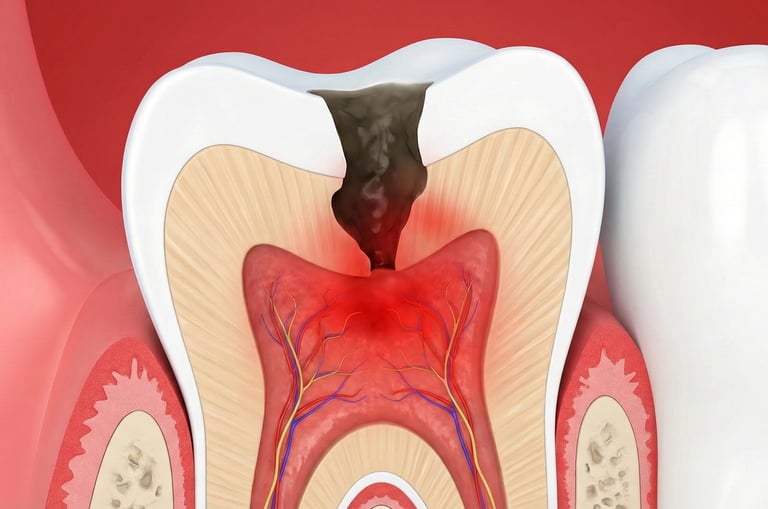
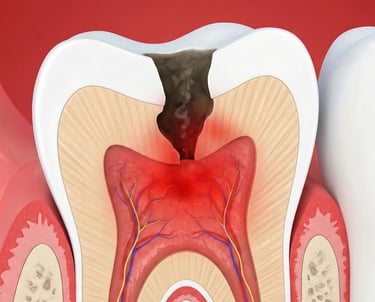
A cross-section of a tooth showing deep decay (black area) that has reached the red, inflamed pulp chamber.
Step 2: Cleaning and Shaping the Canals
After local anesthesia is administered to ensure a painless procedure, an opening is made in the crown of the tooth. Using specialized, fine dental instruments called files, the dentist carefully removes the infected or dead pulp tissue from the pulp chamber and root canals. The canals are then cleaned, disinfected, and shaped to prepare them for filling.
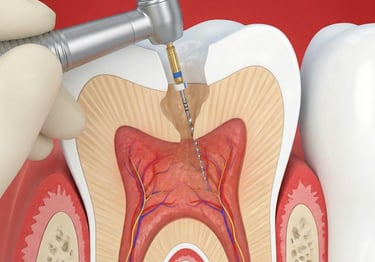
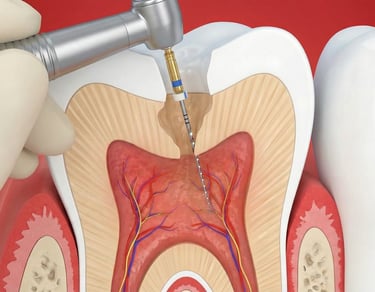
A dentist using a small file to clean the infected pulp from the root canals.
Step 3: Filling and Sealing
Once the canals are thoroughly cleaned and dried, they are filled with a biocompatible, rubber-like material called gutta-percha. The gutta-percha is placed inside the canals and sealed with an adhesive cement to prevent any future infection. The access opening is then closed with a temporary or permanent filling.
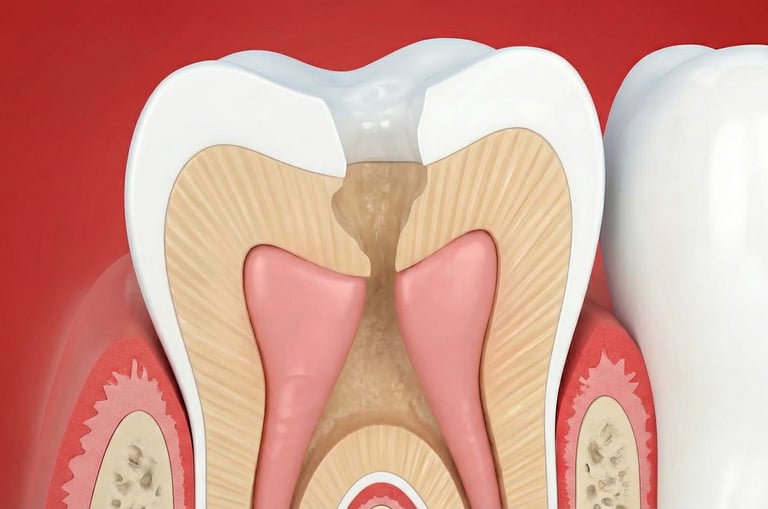
The cleaned root canals are now filled and sealed with the pink gutta-percha material.
Step 4: Final Restoration (Dental Crown)
A tooth that has undergone a root canal is often weaker and more brittle. To protect it from fracturing and to restore its full function and appearance, a dental crown (cap) is usually required. A core build-up is placed in the access opening to provide support for the crown. The final crown is then cemented onto the tooth, completing the restoration.
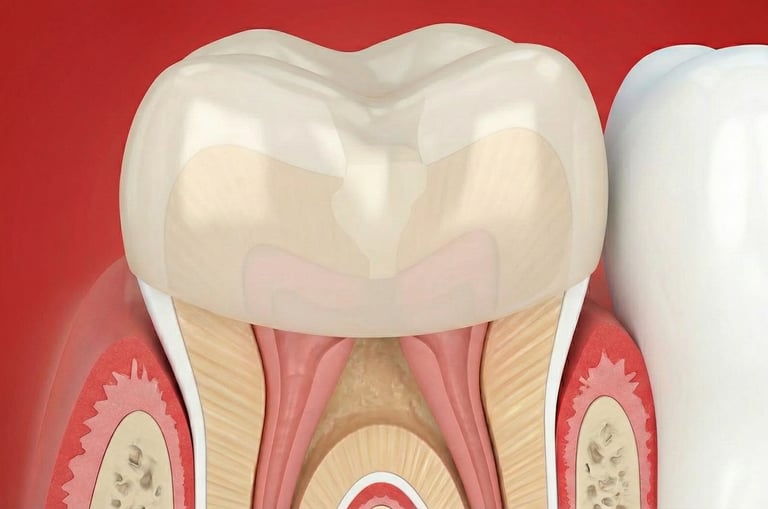
The tooth is fully restored with a dental crown placed over the treated root.